Necromunda Had Been Almost a Roleplaying Game for Years. Now Games Workshop Has Made It Official
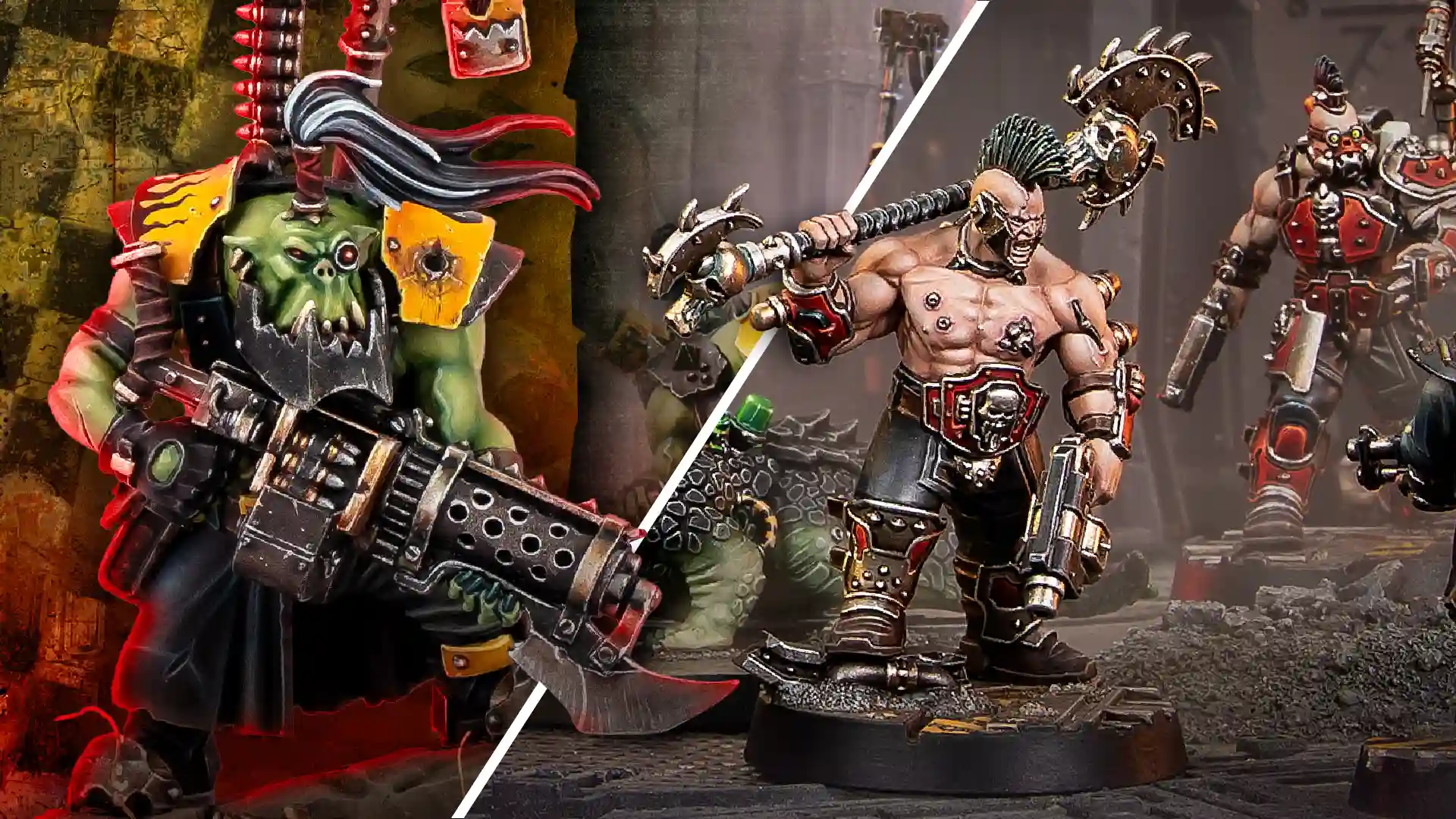
A Necromunda gang has never simply been a handful of miniatures that went back into the box when the game was over. Its members gain experience, suffer injuries that can stay with them for several games, work territories and buy equipment and, with a bit of luck, eventually accumulate enough stories that we stop calling them “that Goliath with the hammer” and start remembering their name.
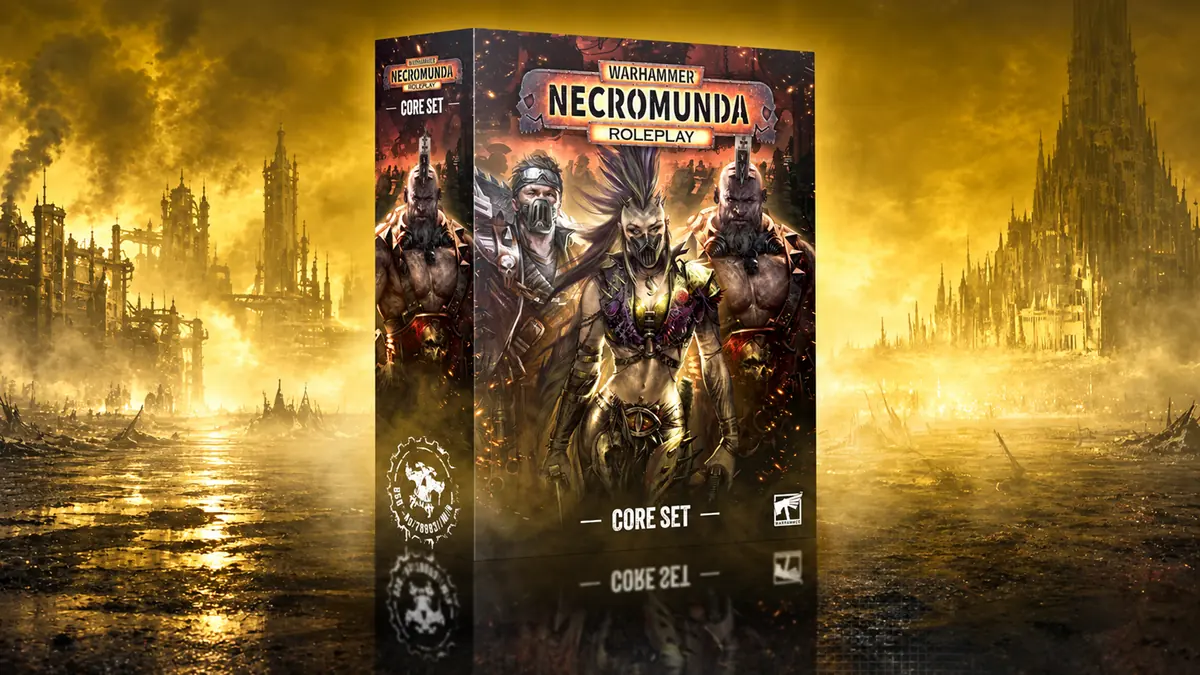
That is why the announcement of Warhammer Necromunda Roleplay is more interesting than simply another game set in the Warhammer universe. Games Workshop describes it as a complete miniature-driven RPG and has even explained that the word Skirmish in the new edition of Necromunda is there to distinguish the two lines. The question is almost inevitable: are we looking at a role-playing game added to Necromunda, or the formalisation of a way of playing that had been hiding inside the game for years?
Necromunda was already living between one game and the next
The new edition of Necromunda Skirmish still makes it fairly clear where an important part of its personality lies. After each confrontation, gang members can recover from their injuries, work the territories they control or train to gain experience. Scenarios can affect those territories, and their consequences continue beyond the battle we have just played.
This is nothing new in the game’s DNA. Necromunda has long followed persistent gangs where experience, advancements, lasting injuries, captures, reputation and possessions accumulated over a campaign all matter. The result is a structure where losing a miniature can mean something considerably more interesting than simply removing a piece from the table.
The figure of the Arbitrator has also existed for years, capable of organising campaigns, introducing special rules or situations and, in some formats, directly controlling the enemies. Hive Secundus, for example, put the Arbitrator in charge of the Malstrain creatures stalking the players throughout an entire campaign. It was not quite a game master in the traditional sense, but the gap was already becoming very small.
Roleplay shifts the focus from the gang to the character
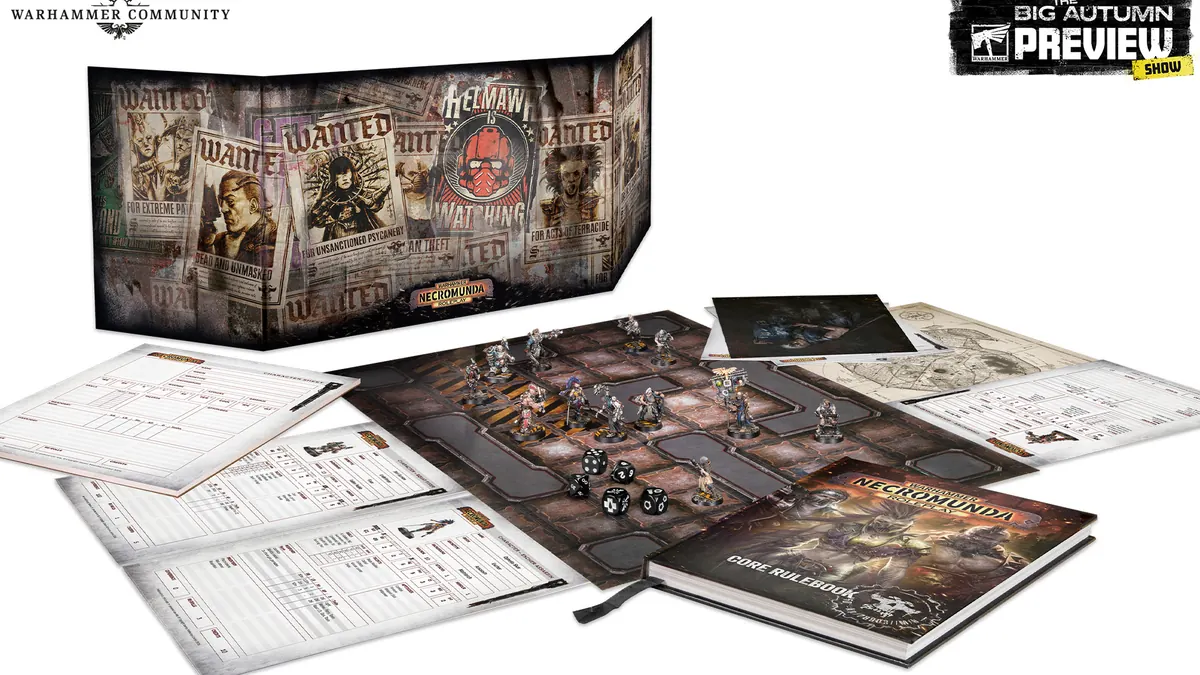
Warhammer Necromunda Roleplay crosses that gap fairly explicitly. Here, players form a group of Venators, bounty hunters who take on jobs prepared by an Arbitrator. Games Workshop directly describes the latter as the equivalent of a game master: they present the story, interpret the rules and develop the narrative around the group’s decisions. The box also includes two complete adventures, An Abominable Intelligence and The Pilgrimage of Bones.
And there is something even more important: the game needs to resolve situations that do not involve shooting another miniature. GW has shown skills such as Acrobatics, Intimidate and Stealth, alongside a system where actions such as intimidating an informant are resolved by trying to roll below a value determined by the character’s skill and the difficulty. The usual Necromunda dice are joined by a D10 and a D100.
We will also be able to create our own Venators. The rulebook will include origins, backgrounds, archetypes and skills for characters from the six Houses, as well as Underhivers and the option to play a Squat. The box will even contain 50 blank character sheets. This is where it becomes difficult to keep talking about simply a more developed campaign: Games Workshop is building tools for role-playing individuals, not just managing a gang.
It is still an RPG that wants to fill the table with miniatures
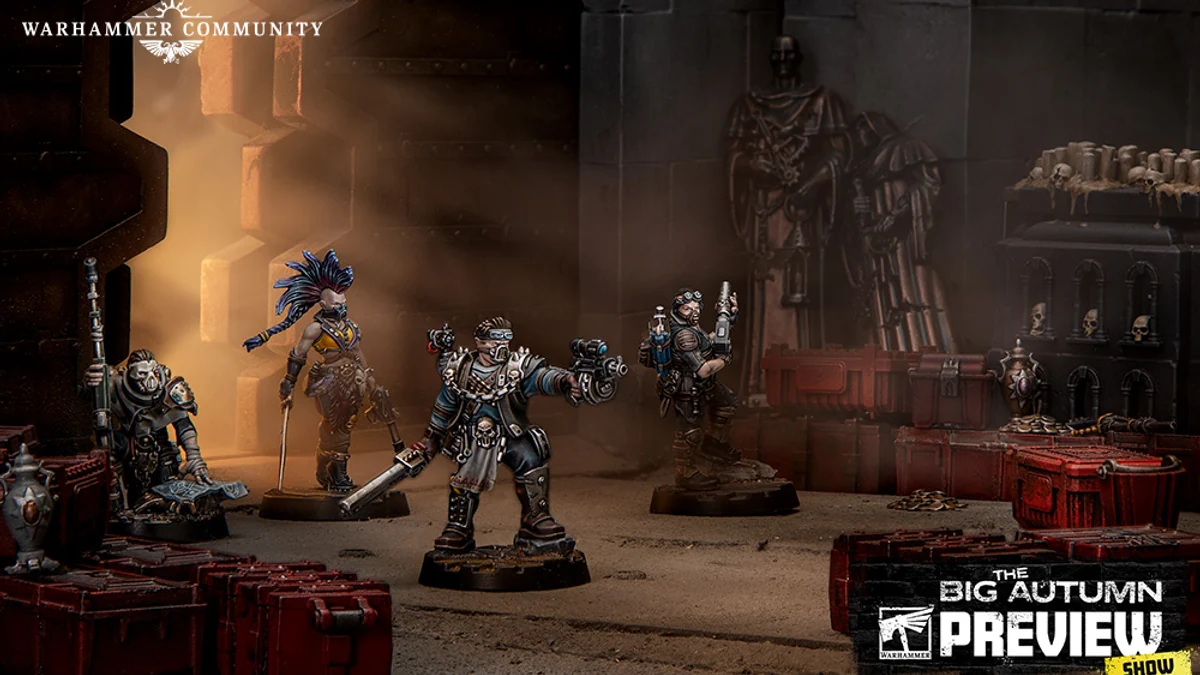
The fact that Necromunda is crossing the boundary into role-playing does not mean it is leaving its origins as a miniatures game behind. In fact, Games Workshop explicitly describes it as a miniatures-based RPG, and combat retains recognisable elements from Skirmish: simple and double actions, hit rolls, injuries and miniatures physically moving around the battlefield.
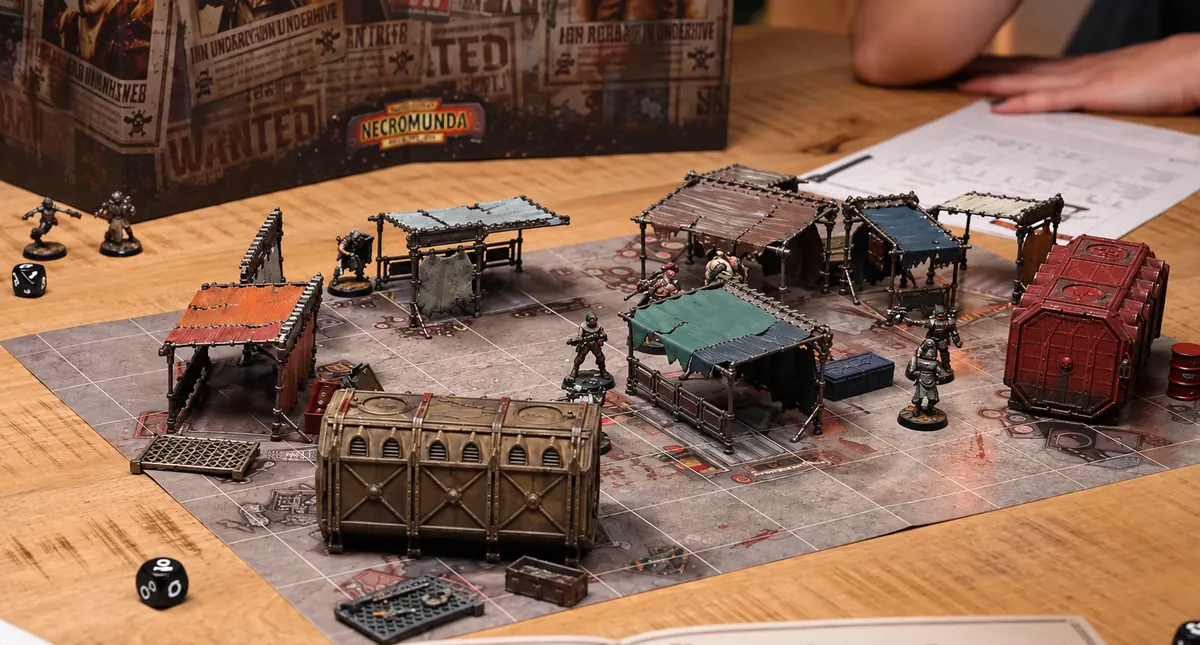
The box itself reflects that philosophy. It includes four pregenerated characters —an Escher assassin, an Orlock gunslinger, a Squat Fixer and a Goliath champion—, five miniatures representing characters and adversaries from the adventures, and eight Hive Scum. There will also be two double-sided mats representing areas of the underhive and the ash wastes, reference cards and an Arbitrator screen.
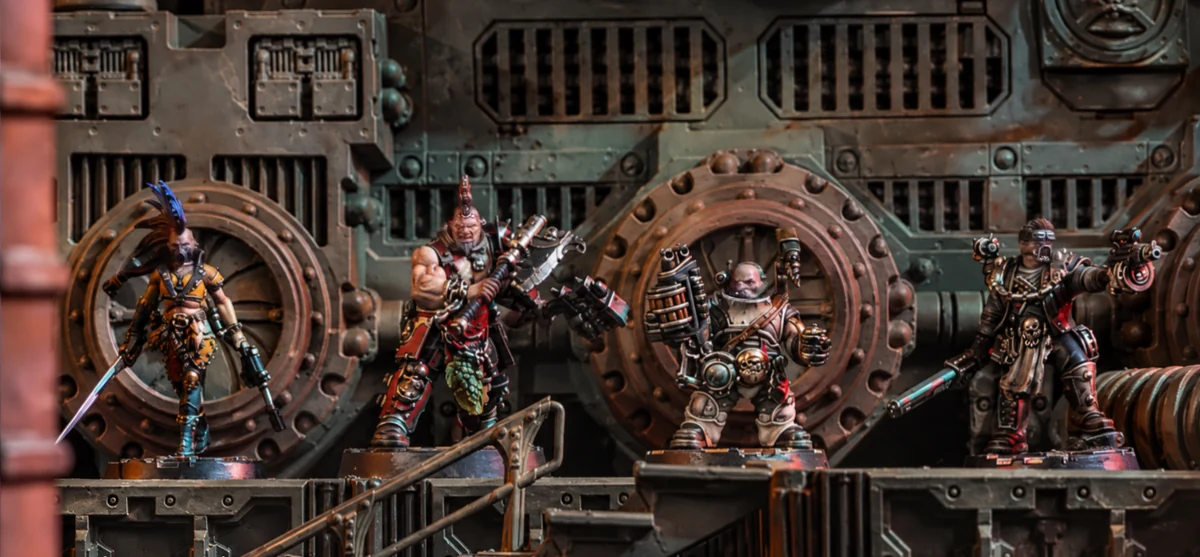
It is an approach deeply connected to the physical hobby. If you already own a Necromunda collection, the game wants you to look at it differently: that Ambot can stop being simply a piece in a gang and become a specific threat in an adventure; an Enforcer can appear as an adversary, and a miniature you painted purely because you felt like it might end up representing a recurring contact. It is an idea close to what interests us about terrain as a narrative tool: miniatures and terrain stop being mere components and start defining places and characters.
Skirmish and Roleplay will share Necromunda, but they are not the same game
Games Workshop seems keen to avoid confusion between the two formats. Necromunda Skirmish will remain the gang and campaign game, while Necromunda Roleplay will have its own rulebook. GW has confirmed that we will be able to use miniatures from the Necromunda range in the RPG, but we will not need any of the Skirmish books to play.
We also know that this will not be an isolated box. Its release will be accompanied by Journal Apocrypha: Denizens of the Hive – Adversaries Book 1, a 48-page supplement containing 51 additional profiles for using miniatures from the Houses, Enforcers, Ogryns, hive dwellers, creatures and characters such as Kal Jericho and Scabs. Games Workshop presents it as the first in a series of expansions.
What GW has not yet confirmed is any direct character conversion between the two rulesets. We know miniatures will be able to move from one table to the other, but not whether a Venator created in Roleplay will be able to automatically carry their character sheet, experience and equipment over to Skirmish. We also still do not have an exact release date or price. And there is another important detail for us: no Spanish-language version has been announced for the initial release. Warhammer Community published the reveal fully translated into Spanish, but Games Workshop has not announced a localisation of the rulebook, character sheets or supplements. At least initially, we should expect to play it in English.
The boundary between wargame and RPG matters less and less
Perhaps the most intriguing thing about Necromunda Roleplay is that it does not seem interested in hiding where it comes from. It is not trying to become a traditional RPG by replacing miniatures with abstract combat, nor does it want us to forget years of Necromunda campaigns. It takes precisely what was already working —persistent characters, injuries, equipment, terrain, an extraordinarily detailed world and an Arbitrator organising the experience— and changes the point of view.
In a game of Skirmish, the question usually begins with what happens to a gang. In Roleplay, it might begin with what an informant knows, what lies behind a door, why a corpse merchant needs our help or whether it is worth accepting a job that will almost certainly end badly. The table and the miniatures are still there. What changes is everything we can do between one gunshot and the next.
Our opinion
We believe Games Workshop is not turning Necromunda into something completely different. It is giving a name and its own rules to a part of its identity that has been asking for more space for a long time. Campaigns already managed to turn a succession of confrontations into characters and stories; Roleplay simply allows those stories to continue when nobody is shooting. And the fact that GW has explicitly separated Skirmish and Roleplay seems more interesting to us than trying to fit both into the same ruleset.
What remains to be seen is how far that freedom outside combat will go and how much room the Arbitrator will have to create their own adventures. If it works, one of its greatest attractions may be precisely looking at a Necromunda collection and starting to see it differently: not as rival gangs, but as an entire population of mercenaries, merchants, monsters, informants and characters waiting for someone to give them a story.